Galo (Rooster)
Article published in Mar do Norte newspaper on 15 July 1921
The results of the research carried out into findings relating to rooster symbolism along the entire Atlantic coast – from Porto to Scotland, via Galicia, as well as various municipalities in France and Ireland – have finally been published. A Celtic symbolism which, with this recent discovery, acquires its own material culture.
Until now, it was known that the term ‘Galo’ (‘rooster’) derived from ‘Gallus’, the Latin word used by the Romans to refer the Celts who inhabited the region of Gaul (as well as the bird). We also find references in the Codex Calixtinus[1] itself, from the Cathedral of Santiago de Compostela, to the legend of the Rooster of Barcelos, as part of the medieval tradition of the Santiago Roads, and in a similar account from Santo Domingo de la Calzada. In France, it has also been used as an unofficial national symbol, having become part of the iconography during the French Revolution, as well as in French and Scottish heraldry.
At the moment, various traces of Celtic symbolism have been found, including triskeles[2]. This is probably an iconography that reveals an art form rooted in identity. The rooster (‘galo’), possibly recognised for its courage and boldness, is also thought to be associated with the terms ‘Gaelic’, ‘Gallus’, and ‘Gallaecia’. The matter is now in the hands of the linguists, who will shortly complete their own research, the results of which we will present to our readers.
Similarly, a group of cultural activists from the Monarchy of the North argues that, rather than the Dragon of the city of Porto, it is the Rooster that should symbolise the Monarchy of the North, even though this symbol does not belong exclusively to Northern Portugal, but rather to the entire Atlantic Celtic culture. It is, therefore, a controversial position.
[1] An illuminated manuscript from the mid-12th century, comprising a collection of Latin texts compiled in Compostela during the final years of Diego Gelmírez’s archbishopric, intended to promote that See.
[2] A symbol consisting of three intertwined spirals, three bent human legs, or any similar design conveying the idea of rotational symmetry. It is the identifying symbol of five European regions: Brittany, the Isle of Man, Galicia, Northern Portugal and Sicily. The triskelion of Galicia and Northern Portugal consists of three crescent moons rotating about a single point. The triskelion of Brittany is also a Celtic symbol.
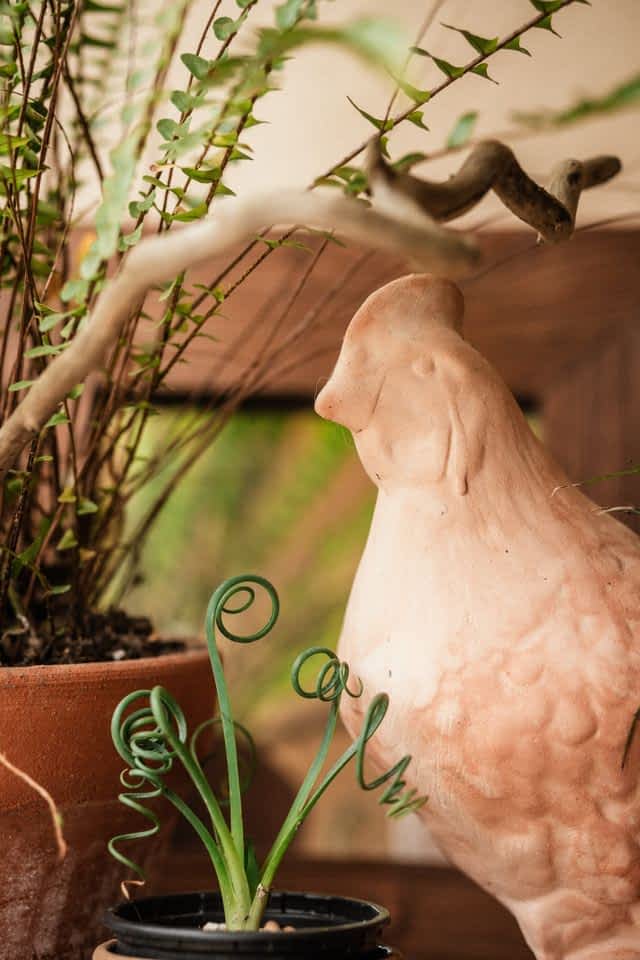 @TIVASEE. (https://www.pexels.com/pt-br/foto/natureza-decoracao-galinha-crescimento-22856347/)
Comments