Rahtisahti
Excerpt from the newspaper Turun Sanomat marking the anniversary of the alliance between the Northern Monarchy and the Finnish Monarchy.
[…]
1918
October, 8
Prince Frederick Charles of Hesse is elected King of Finland.
November, 11
Germany surrenders. General Rüdiger von der Goltz, commander of the German Baltic Sea Division, refuses to recognize the new republican government in Berlin or lay down his arms. He intends to use the Kingdom of Finland as the foundation for restoring the German Empire, turning the country into the last stronghold of the fallen Kaiserreich[1].
December, 16
Persuaded by von der Goltz, king Frederick travels to Finland, claims his throne and sovereignty over the entire country. Turku is selected as the capital of the Kingdom. The Republic of Finland, led by Kaarlo Juho Ståhlberg from its temporary capital in Vaasa, refuses to recognize the king and demands the withdrawal of all German forces.
December, 18
Finland descends into a new civil conflict: the Kingdom controls Turku and much of Southwest Finland, while the Republic, governing from Vaasa, holds the rest of the country.
1919
January, 7
The Battle of Eurajoki, the first battle between the Kingdom of Finland and the Republic of Finland. Von der Goltz’s outnumbered army consists of German troops who refused to return home, foreign volunteers, and Finnish monarchists. Von der Goltz’s army has two A7V tanks, but the Kingdom’s army is forced to withdraw when their fuel supplies run dangerously low. The Republican Army is unable to exploit the situation due to shortages of ammunition and munitions. The battle ends inconclusively.
March, 15
King Frederick opens diplomatic negotiations with king Manuel II. The Kingdom of Finland offers to recognise the Portuguese Monarchy and proposes an exchange of German military engineering expertise for Portuguese assistance in war against the Republic of Finland.
March, 25
Although Manuel II is first reluctant to help a German born king, he cannot turn his back on a potential ally. Portugal sends three barrels from Mechnikoff’s experimental batch of unfiltered, port-wine-derived biofuel to Turku for evaluation. Because production is still in its infancy and refined fuel is urgently needed for the defence of Portugal, the Kingdom can spare only a small quantity of the unfinished experimental fuel.
April, 28
Biofuel shipment arrives to Turku.
May, 1
The engineers at Turku armoury, who have been celebrating ‘Walpurgis Night’[2], continue by celebrating the king’s birthday. They discover biofuel barrels, mistake the content as port wine, and drink most of it.
May, 3
The Turku armoury engineers panic as they realize their mistake. After analyzing the barrels, they find that a thick layer of yeast sediment had settled at the bottom of the casks. After analyzing the sediment with microscopes, the armoury engineers start to search for similar yeast strains from old sahti (Finnish farmhouse ale) breweries, juniper branches, malt houses, and commercial breweries.
June, 10
A promising wild yeast strain specific to a certain sahti brewery near the Turku harbour is found. Their sahti contains one third of rye and two thirds of barley.
June, 17
First batch of sahti is ready. It is fortified with rectified spirit (pirtu, or kolmasti kirkastettu i.e. ‘triple-distilled moonshine’) sourced from Estonia. The result is called rahtisahti[3] (‘Freight Sahti’), also known as satamasahti (‘Portside Sahti’).
June, 27
Initial trials of rahtisahti are succesful.
July, 8
Production of rahtisahti is started in Turku. Because the Kingdom cannot distil enough rectified spirit domestically, supplies are smuggled across the Gulf of Finland by Estonian bootleggers. The Republican Navy wages a relentless campaign to intercept these shipments, making control of the sea lanes as vital as the battles fought on land.
August, 1
Without access to the rahtisahti yeast strain, the Republic pursues a different technological path. Drawing on Finland’s long tradition of tar production, republican engineers develop heavy tar-fired engines resembling crude diesel engines.
October, 26
Although abundant and inexpensive, tar proves to be a poor fuel. The first tar engines are notoriously unreliable, difficult to start, prone to fouling and overheating, and require constant maintenance. Nevertheless, the Republic continues to improve this technology in the hope of closing the gap with the Kingdom’s superior alcohol-powered machines.
[…]
[1] German term for an empire, i.e. a state ruled by an emperor (‘Kaiser’s realm’).
[2] Celebrated on the night of 30 April and the day of 1 May, this feast commemorates the canonization of Saint Walpurga and the movement of her relics to Eichstätt, both of which occurred on 1 May 870. It’s a community celebration, with bonfires being lit across the country, while people sing songs of spring and drink several beverages.
[3] Wordplay combining the Finnish words rahti (freight/cargo) and sahti (a traditional Finnish farmhouse ale), creating a popular, playful rhyming.
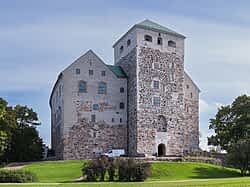 Autor desconhecido / Unknow author; Domínio público/ Public domain; Parte da Coleção do Turku Museum Centre / Part of Turku Museum Centre (https://commons.wikimedia.org/wiki/Category:Turku_Castle)
This entry is part of the Finnish Osuuskumma co-operative stories. // Esta publicação é parte das história da cooperativo Finnish Osuuskumma.
Prince Frederick Charles of Hesse was elected as king of Finland, but he never accepted the throne and Finland’s status as a republic was confirmed in the Finnish Constitution of 1919. General Rüdiger von der Goltz was commander of the German Baltic Sea Division stationed in Finland. // O príncipe Frederico Carlos de Hesse foi eleito rei da Finlândia, mas nunca aceitou o trono, tendo o estatuto da Finlândia como república sido confirmado na Constituição finlandesa de 1919. O general Rüdiger von der Goltz foi o comandante da Divisão Alemã do Mar Báltico, alocada à Finlândia.
Comments